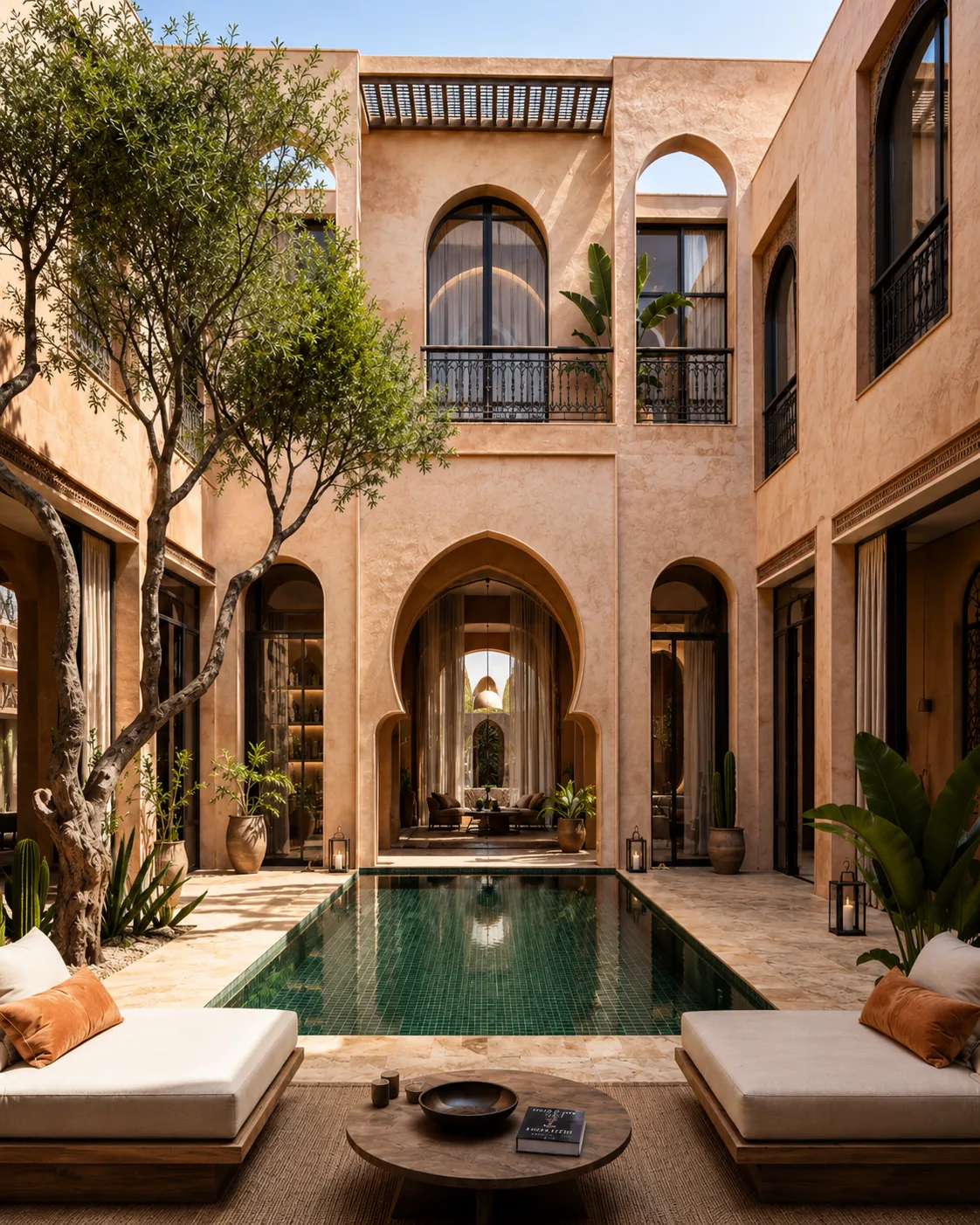
Riad renovation cost in Marrakech: the real budgets per m²
"How much does it cost to renovate a riad?" is the first question we hear — and the honest answer is: it depends on the building's condition, the access, the finish level and the intended use. Two neighbouring riads of the same size can call for budgets three times apart.
This guide shares the ranges our studio actually uses to frame projects in Marrakech, the factors that move the bill, the costs almost everyone forgets, and a worked example from end to end.
Three levels of renovation, three budgets
In Marrakech, works budgets fall into three practical families, excluding the purchase price and furniture:
- Light renovation — roughly €170 to €450 per m²: the riad is sound; renders and tadelakt are refreshed, bathrooms redone, part of the electrics, joinery and paint.
- Full renovation — roughly €370 to €560 per m²: all services redone (plumbing, electricity, air conditioning), bathrooms and kitchen rebuilt, new joinery, terrace waterproofing and complete artisanal finishes.
- Heavy restructuring — roughly €560 to €750 per m²: structural repairs, a redesigned patio, extension or an added floor, deep heritage restoration.
What moves the price from one riad to the next
Five factors explain most of the gap between two quotes — and none of them show on the listing photos:
- Structure and damp: old walls, rising damp and terrace waterproofing are the medina's classic pathologies, and treating them weighs heavily.
- Real surface area: patios, galleries and double heights mean a "200 m²" riad can develop far more surface once everything to be treated is counted.
- Access: a narrow lane means materials in by hand or by mule and rubble out the same way — you pay for it in labour and time.
- Finish level: beldi zellige, tadelakt, cedar wood and carved plaster have neither the price nor the craftsmen of standard finishes.
- Intended use: a guesthouse needs more bathrooms, guest-friendly circulation and equipment that meets operating standards.
The costs buyers forget to budget
The ranges above cover the works. Around them, several items belong in the envelope from day one:
- Architect fees: for a full mission (design, permits, site supervision), the most common bracket is 10% to 15% of the works value.
- Permits: a works authorisation or building permit file, reviewed by the heritage authorities — the medina is a UNESCO World Heritage site.
- Contingency: allow 10–15% of the works budget; demolition almost always reveals surprises in an old building.
- Furniture and equipment, plus utility connections and meter upgrades.
A worked example: a 180 m² riad
Take a riad with 180 m² of surfaces to treat, in full renovation: 180 m² × €370–560 per m² gives a works budget of roughly €67,000 to €101,000.
Adding full-mission fees and a contingency reserve, the total envelope lands around €80,000 to €125,000. That order of magnitude — not the per-m² price alone — is what to hold in mind before committing.
How to secure your budget before committing
The best investment of the whole project is a pre-purchase survey: a technical visit that objectifies structure, damp and real floor areas, and produces a first budget envelope. You negotiate the price with facts, and you walk away from riads whose pathologies outweigh the discount.
From there, the budget is secured by method: trade-by-trade pricing on precise drawings, contractors tendered in competition, and spending tracked throughout the works by the same team that designed the project.
Every riad is different: these ranges frame a project, they do not replace a quote. A visit and a first reading of the building are usually enough to place your project in the right budget family.
Keep reading
- Our riad renovation service in Marrakech
- Buying a riad to renovate: the guide
- Understanding architect fees